All posts by Flavio Monfrini

Italy – At Last – Implemented the Registry of UBOs (Ultimate Beneficial Owners)

All legal entities established in Italy are affected by the new regulation, which provides for a December 11, 2023 deadline.

The register of ultimate beneficial owners has been established and has become
operational also in Italy, after several extensions and delays. In fact, on October 9,
2023, the decree certifying the operation of the system for the communication of
data and information on beneficial ownership was published in the Official Gazette.

This last decree, which completes the implementation of anti-money laundering
legislation, triggers the obligation for all companies, private legal entities
(associations, foundations and other institutions of a private nature with legal
personality) and trusts to communicate data and information relating to their
beneficial ownership.

The communication on beneficial ownership must be made to the Companies’
Registry at the territorially competent Chamber of Commerce by and no later than
December 11, 2023, using exclusively electronic methods. With regard to
companies, the communication must be digitally signed by a director, without the
possibility to delegate such task. Therefore, directors who do not yet have a digital
signature device will need to obtain one.

Subsequently, legal entities shall notify any change in their beneficial ownership
within 30 days of the occurrence of the change. In addition, on an annual basis (and
in any case within 12 months from the first communication), the beneficial
ownership shall be confirmed: for companies this may take place on the occasion
of the annual filing of the financial statements.

For more information on the new requirements, check out our Client Alert here or reach out to us directly.

Excellent, Again!

We are very proud to share that our practice has been recognized once again for its “excellent” work in the 2023 rankings of Leaders’ League for the Healthcare, Pharmaceutical and Biotech sector in Italy.

Striving for excellence is our goal and we are thankful to our clients and colleagues who have made all of this possible and continue to trust us.

The full rankings are accessible here: https://www.leadersleague.com/en/rankings/healthcare-pharmaceuticals-biotech-sector-health-pharmaceutical-industry-ranking-2023-law-firm-italy

Looking forward to many more future achievements!

New Whistleblowing Legislation Adopted in Italy

Italy has implemented today the EU whistleblowing directive (UE) 2019/1937. The new legislative decree no. 24/2003 has in fact been published on the official journal and is scheduled to enter into force on March 30, 2023.

The final published version of the decree, which had been previously leaked in an unofficial draft, can be found here: https://www.gazzettaufficiale.it/eli/id/2023/03/15/23G00032/sg.

The new legislation is certain to affect private companies and public entities alike when it comes to managing whistleblowing reports and new measures may need to be adopted to comply with the new requirements.

For additional information on this subject, materials from our February webinar can be freely accessed here: https://lawhealthtech.com/2023/02/09/our-whistleblowing-webinar/.

Google Analytics under Scrutiny by Italian Data Protection Authority

The second issue of our summer series focuses on the recent decision by the Italian Data Protection Authority, which affects all users of the Google Analytics services in Italy, as well as other similar services that entail the transfer of users’ personal data to the United States.

Read our slides to understand what actions are available to you.

New Guidelines on Patient Support Programs Adopted by Italian Pharma Industry Association

New guidelines on patient support programs have been adopted by the Italian pharmaceutical industry association (Farmindustria) on January 19, 2022. The new guidelines have been incorporated in a new release of the industry ethical code, where also several provisions regarding educational activities, market access and scientific data exchange have been updated.

Patient support programs are not expressly regulated under Italian law and, for such reason, the guidelines issued by Farmindustria are particularly helpful in identifying the best market practices. The new guidelines define patient support programs as initiatives implemented by pharmaceutical companies aimed at making available additional services for the direct benefit of patients. Such services are not intended to replace the services of hospitals and other healthcare organizations.

Patient support programs can only be implemented in connection with medicinals that have received a marketing authorization, for the sole purpose of providing information on the correct use of the medicinal product and to foster patients’ compliance with its administration. They can never have a promotional purpose.

The new Farmindustria guidelines expressly acknowledge that patient support programs may be implemented by pharmaceutical companies through a third party service provider, which may carry out services in favour of patients by means of adequately qualified professionals. The pharmaceutical companies, however, continue to have overall responsibility for the program.

A noteworthy innovation has been adopted with regard to the processing of patients’ personal data. In fact, the new guidelines provide that pharmaceutical companies must not directly process the data of patients enrolled in a patient support program, and should rather only access aggregated data for statistical purposes on the use of the services. 

This latter provision is particularly troublesome from a data protection standpoint, as it may be interpreted as preventing pharmaceutical companies from acting as data controllers in connection with the deployment of patient support programs, even if they remain responsible for the programs themselves. Therefore, new mechanisms shall be implemented to segregate identifiable data and prevent their processing by pharmaceutical companies unless they are previously de-identified.

Facial Recognition Technology: Are We Close to a Turning Point?

When people think about facial recognition technology (“FRT”), they immediately imagine the use of their faces to unlock their smartphones. But this technology is far more complicated, useful and potentially dangerous.

First, it is important to understand the difference among “facial detection”, “facial characterization”, “facial identification” and “facial verification”. Such terms have been defined by the non-profit organization Future of Privacy Forum (https://fpf.org/wp-content/uploads/2019/03/Final-Privacy-Principles-Edits-1.pdf) as follows:

  • Facial detection simply distinguishes the presence of a human face and/or facial characteristics without creating or deriving a facial template.
  • In facial characterization the system uses an automated or semi-automated process to discern a data subject’s general demographic information or emotional state, without creating a unique identifier tracked over time.
  • Facial Identification is also known as “one-to-many” matching because it searches a database for a reference matching a submitted facial template and returns a corresponding identity.
  • The last one, facial verification, is called “one-to-one” verification because it confirms an individual’s claimed identity by comparing the template generated from a submitted facial image with a specific known template generated from a previously enrolled facial image.

There are many possible uses of facial recognition. In the private sector FRT may be used to keep track of employees’ time and attendance, identify shoppers’ patterns inside stores, implement smart homes, etc. In the public sector, FRT may be used to monitor protests, identify suspects in security footage, check claimed identities at borders, etc.

This relatively new technology brings, besides a wide range of possible implementations, significant concerns regarding privacy, accuracy, race and gender disparities, data storage and security, misuse. For instance, depending on the quality of images compared, people may be falsely identified. In addition to that, in its current state, FRT is less accurate when identifying women compared to men, young people compared to older people, people of color compared to white people. Privacy is certainly another concern: without strong policies it is unclear how long these images might be stored, who might gain access to them or what they can be used for; not to mention that this technology makes far easier for government entities to surveil citizens and potentially intrude into their lives (see “Early Thought & Recommendations Regarding Face Recognition Technology”, First report of the AXON AI and policing technology Ethics Board https://www.policingproject.org/axon-fr).

Once the possible implementations and the related risks are understood, the worldwide lack of regulation becomes even more surprising.

Within the European Union, the General Data Protection Regulation obviously applies to FRT. Furthermore, “Guidelines on Facial Recognition” have been released on January 28, 2021 by the Consultative Committee of the Council of Europe with regard to automatic processing of personal data (https://rm.coe.int/guidelines-on-facial-recognition/1680a134f3). This latter document includes:

  • Guidelines for legislators and decision-makers;
  • Guidelines for developers, manufacturers and service providers;
  • Guidelines for entities using FRT;
  • Rights of data subject.

When it comes to Italy, particular attention has been drawn by several decisions of the Italian Data Protection Authority on the topic. Recognizing the innovative potential of FRT as well as its riskiness for individual rights, the Authority adopted a more permissive approach regarding the private sector’s use of FRT, while issuing stricter decisions with regard to the use of FRT by public authorities. For instance, the Authority allowed the use of FRT by police forces for purposes of identifying individuals among archived images, but prohibited real-time surveillance using the same technology (see https://www.garanteprivacy.it/web/guest/home/docweb/-/docweb-display/docweb/9040256 and https://www.garanteprivacy.it/web/guest/home/docweb/-/docweb-display/docweb/9575877). On the other hand, the Authority allowed one airport to implement FRT for purposes of improving efficiency in the management of the flow of passengers, so long as images of individuals were not stored (see https://www.garanteprivacy.it/web/guest/home/docweb/-/docweb-display/docweb/8789277).

The European Commission, in light of the complexity of the situation and the necessity of a strong and harmonised legislative action, presented on April 21, 2021 its “Proposal for a Regulation of the European Parliament and of the Council laying down harmonised rules on artificial intelligence” (https://eur-lex.europa.eu/legal-content/EN/TXT/?uri=CELEX%3A52021PC0206). This Proposal was already the subject, on June 18, 2021, of a EDPB and EDPSs’ joint-opinion (https://edpb.europa.eu/our-work-tools/our-documents/edpbedps-joint-opinion/edpb-edps-joint-opinion-52021-proposal_en), in which they called for a general ban on the use of FRT for:

  • Automated recognition of human features in publicly accessible spaces;
  • Categorization of individuals into clusters according to ethnicity, gender, etc., based on biometric features;
  • Inference of individuals’ emotions.

What the European Commission is doing is an example of a more globally widespread legislators’ attitude towards artificial intelligence in general and FRT in particular. These technologies are more and more in our lives and are constantly evolving. Consequently, there is an increasing request, both from public and private subjects, for clear rules to govern this new technology and ensure that individual rights are safeguarded. Hopefully in the next months/years the situation will become clearer.

Flavio Monfrini / Michele Galluccio

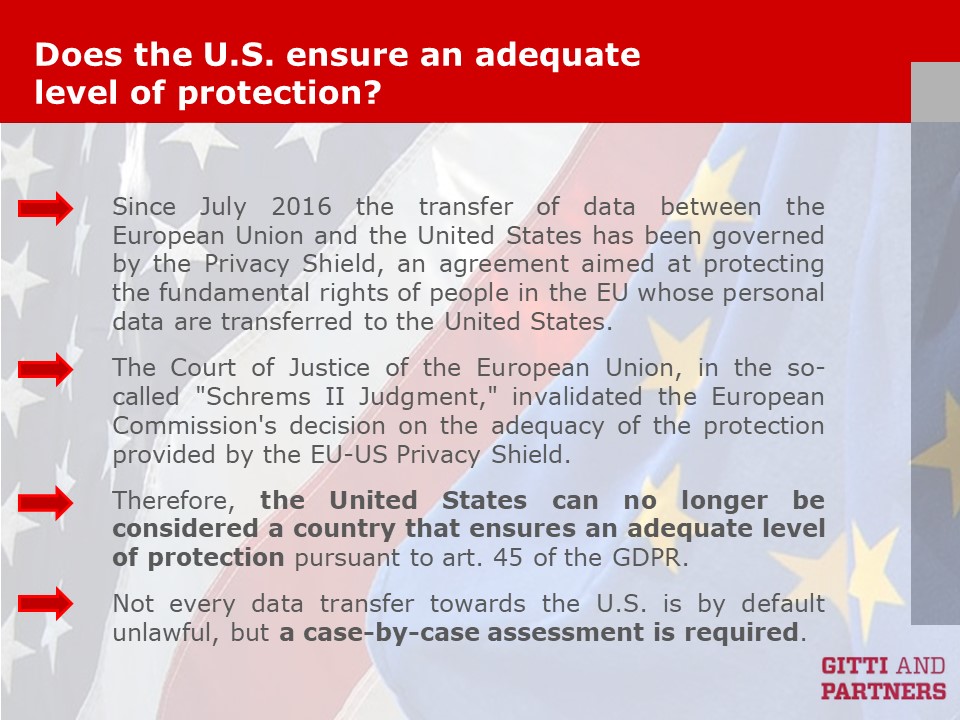
The European Court of Justice Strikes Down the EU-US Privacy Shield

Yesterday, on July 16, 2020, in a landmark decision, the Court of Justice of the European Union ruled that the key data-sharing mechanism, the EU-US Privacy Shield, is invalid, as it failed to protect privacy and data protection rules.

The case behind the decision.

Maximillian Schrems, an Austrian national residing in Austria, who has been a Facebook user since 2008, lodged a complaint with the Irish supervisory authority seeking, in essence, to prohibit the transfer of his personal data by Facebook Ireland to servers belonging to Facebook Inc., located in the United States. In its recent decision, the Court expressed the view that «the limitations on the protection of personal data arising from the domestic law of the United States on the access and use by US public authorities of such data transferred from the European Union» are «not circumscribed in a way that satisfies requirements that are essentially equivalent to those required under EU law, by the principle of proportionality, in so far as the surveillance programmes based on those provisions are not limited to what is strictly necessary» (the full Court press release is available here: https://curia.europa.eu/jcms/upload/docs/application/pdf/2020-07/cp200091en.pdf.

According to the BBC, Max Schrems called it a win for privacy, stating that «it is clear that the US will have to seriously change their surveillance laws, if US companies want to continue to play a role in the EU market» he said, while the US Secretary of Commerce Wilbur Ross said his department was “deeply disappointed” by the decision and said he hoped to «limit the negative consequences to transatlantic trade worth $7.1 trillion (£5.6tn)» https://www.bbc.com/news/technology-53418898.

Impact and remedies.

The Court held that standard contractual clauses will continue to be a valid means for the transfer of data outside the European Union.

Therefore, companies currently benefitting from the EU-US Privacy Shield will likely transition to standard contractual clauses. Microsoft, for example, has issued a statement saying it already uses them and is unaffected by the recent Court decision (the full statement is available here: https://blogs.microsoft.com/eupolicy/2020/07/16/assuring-customers-about-cross-border-data-flows/.

While we are slightly surprised by the decision, we must confess it has been years since we last suggested a client to use the Privacy Shield: standard contractual clauses have always been an easier and more flexible tool.

MDR: the Postponement to 2021 is Official

On April 24, 2020 the new Regulation (EU) 2020/561 officially entered into force, postponing the date of application of most Medical Devices Regulation (MDR) provisions to May 26, 2021. The final text of the regulation can be found here: https://eur-lex.europa.eu/legal-content/EN/TXT/HTML/?uri=CELEX:32020R0561&from=EN.

The postponement was approved unanimously and was considered unavoidable since the outbreak of the covid-19 pandemic in early 2020 made it very clear that businesses, notified bodies and regulators would not be ready in time for the entry into force of the MDR requirements in May 2020.

The European Commission noted, with some relief, that  “this postponement takes the pressure off national authorities, notified bodies, manufacturers and other actors so they can focus fully on urgent priorities related to the coronavirus crisis” (https://ec.europa.eu/growth/sectors/medical-devices_nn).

While the postponement might have been triggered by the covid-19 pandemic, there is no doubt it now gives regulators and the industry alike the chance to remedy the delays that have accumulated over the past few years, with the hope that they will come prepared to the new deadline of May 2021.

No CE Marking Required for Surgical Masks and Personal Protective Equipment

In the wake of the COVID-19 pandemic, the Italian Government lifted regulatory requirements for the manufacturing, importing and placement on the market of surgical masks and other personal protective equipment.

The measures were prompted by a failure of existing manufacturers and importers to meet the demands of hospitals, healthcare professionals and individual citizens alike, and are seen as generally in line with the Commission Recommendation (EU) 2020/403 of 13 March 2020 on conformity assessment and market surveillance procedures within the context of the COVID-19 threat (https://eur-lex.europa.eu/legal-content/GA/TXT/?uri=CELEX:32020H0403).

The new emergency regulations (law decree 18/2020 – http://www.governo.it/it/articolo/decreto-legge-17-marzo-2020/14333) provide that manufacturers, importers and other businesses who intend to commercialize surgical masks and personal protective equipment, are required to submit a self-certification to the National Health Institute (“Istituto Superiore di Sanità” – https://www.iss.it/) or to the National Workers Insurance Agency (“INAIL”) respectively, whereby they describe the technical specifications of the devices/equipment and declare that the devices/equipment meet the safety requirements set forth in applicable legislation. The competent authorities are then required issue a compliance decision within 3 days from the submission.

The technical procedures for the submission to the authorities have now also been implemented and, with reference to surgical masks, they require an additional certification from the applicants concerning the compliance of the devices with quality standards UNI EN 14683:2019 and UNI EN ISO 10993-1:2010. A quality system should also be implemented, but such system does not need to be certified: the implementation of adequate procedures and traceability measures would be sufficient to meet the applicable requirements.

While certain regulatory requirements are meant to remain place in order to ensure the reliability of products placed on the market, the authorities are hopeful that the new emergency measures will provide relief to hospitals and healthcare operators operating under the current extraordinary circumstances.

Five Key Takeaways from Our Seminar on Clinical Trials

If you missed our seminar on clinical trials on January 16, here are five key takeaways to help you understand the changing regulatory environment in Europe and Italy.

  1. Be ready for a new regulatory landscape

The recent clinical trials regulatory overhaul within the EU aims at fostering research and facilitating the tasks of all actors involved in this area. However, delays in the implementation of such new legislation are posing an actual risk for the entire sector throughout the EU, while competition from emerging economies is getting stronger.

  1. Harmonized, but not enough

In several areas, such as observational studies or ethical committee’s assessments, a unified approach at European level is yet to be adopted. This leaves a lot of fragmentation among the various countries and a lot of work to be done at local level in order to ensure compliance with applicable regulations. Be prepared to deal with such inconveniences, in particular in the pharmaceutical sector.

  1. Changes in data protection laws offer new opportunities but challenges remain

GDPR brought new harmonized provisions to improve and support the use of data for the purpose of conducting research. However, guidance from national data protection and regulatory authorities in areas such as legal grounds for processing and secondary use is far from established. Moreover, different EU countries continue to adopt opposite approaches when it comes to consent and legitimate interest as valid legal grounds for data processing in the framework of clinical research. Data protection compliance will therefore continue to require local check-ups.

  1. New opportunities for independent research

Recent regulatory changes in Italy are being implemented to foster independent not-for-profit research in the clinical area. The new regulations, which are about to be adopted, envisage new opportunities for the participation of private actors in independent research and allow not-for-profit research institutions to better exploit the results of their research. The potential for conflicts remain and caution should be exercised within public-private relationships, but there is hope that new paradigms of collaboration will see the light.

  1. A new world of evidence is out there

More and more projects in the clinical research field involve real world data and real world evidence, gathered in a number of different ways outside the rigid protocols of a controlled study, whether through medical devices or other data collection instruments. Real world data are key to understanding how treatments work in reality and developing new healthcare paths. However, both clinicians and private actors are operating in uncharted territories and the line between studies and alternative research projects is thinner than you may expect. Be mindful of the regulatory and compliance ramifications of these new powerful tools.