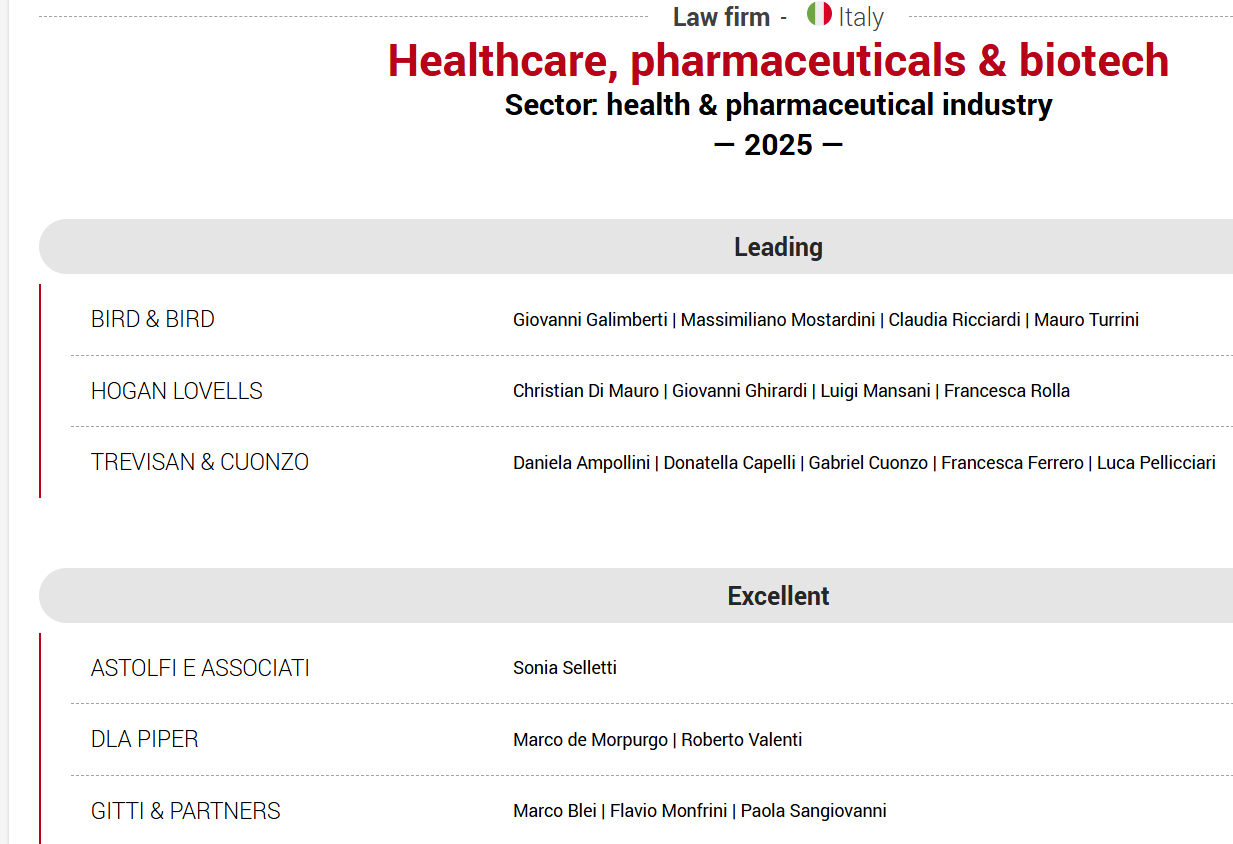
Leaders League rankings are out. Great to be recognized again, this year too!
Our wonderful team gets noticed. And deservedly so.

Leaders League rankings are out. Great to be recognized again, this year too!
Our wonderful team gets noticed. And deservedly so.
Many of our clients encounter challenging dilemmas when public hospitals fail to reimburse the supplies they provide. Our seminar, held yesterday in our auditorium, was designed to discuss risks and potential solutions.
We regret if you were unable to attend, particularly as it was followed by an enjoyable aperitivo. However, we have included the slides presented by our attorneys, Fabrizio Sardella, Damiano Pallottino, and Francesco Clerici, who offered an analysis of the topic from a criminal, administrative, and civil law perspective.
Our life sciences team at Gitti and Partners is happy (and a bit proud!) to announce that this year we have been listed in all top legal directories:
We are VERY grateful for your continued support!
On March 5, 2025 the Ministry of Health’s decree on “EDS” was finally published. What is EDS and why is it important for life sciences companies?
“EDS” stands for “ECOSISTEMA DATI SANITARI” (health data eco system), a system regarding health data that will be active by March 31, 2026. The new ministerial decree clarifies the architecture of EDS, its content and its necessary safety measures.
EDS will be populated with data deriving from the electronic health record (fascicolo sanitario elettronico). With regard to processing for cure, prevention and international prophylaxis purposes, personal health data will be processed on the basis of consent and subject to information to the patient. Only in case of emergency access to EDS will be temporarily possible to healthcare providers even in the absence of consent.
Anonymized health data included in EDS will be available for the purpose of study and scientific research in the medical, biomedical and epidemiological field.
What’s new? Private and public entities with an institutional research mission may request an extraction of anonymized data by submitting a description of the scientific research they intend to carry out that complies with data protection recommendations. Agenas will evaluate data requests and grant access to the anonymized data.
Hungry for content? The life sciences practice of Gitti and Partners has an interesting program of webinars/seminars in store for you within the framework of the EUROPEAN BIOTECH WEEK 2024:
See you soon!

Our breakfast presentation series dedicated to AI continues. Join us for our next event on May 24, 2024 at 9 via Dante in Milan! Our partner, professor Camilla Ferrari of the University of Milan, will be speaking about the impact of AI on contracts.
Curious about past presentations on AI and AI liability? You may find below our slides (in Italian).
The rankings of The Legal 500 are out and this year Gitti and Partners’ life sciences practice has been recognized as a “Tier 2” firm, with Paola Sangiovanni as “Leading Individual”.
Check out the rankings here:
https://www.legal500.com/c/italy/industry-focus-healthcare-and-life-sciences/
A huge THANK YOU to our wonderful testimonials, but also to all of our clients, who help us get better year after year, and to our team, who makes working fun!
Although not revolutionary, these two new pieces of legislation are certainly of great interest to life sciences companies operating in Italy. They may, in fact, entirely change the quantity and quality of information available on and to life sciences companies, and perhaps even impact the cultural landscape in which such companies operate.
–> INFORMATION IN: the Whistleblowing Act is designed to encourage a flow of information to the company;
<– INFORMATION OUT: the Italian Sunshine Act will ensure that interactions with HCPs or HCOs are publicly disclosed, which will generate information from companies out to the public.
THE SUNSHINE ACT.
THE WHISTLEBLOWING ACT.
Both laws rest on the assumption that corruption is inherent in businesses, especially in life sciences’ companies, and should be unearthed, even in an industry that is heavily regulated, self-regulated, and closely monitored by regulators and authorities.
Will the Sunshine Act and the Whistleblowing Act change the perception of life sciences companies? Will their efforts in terms of transparency and accountability be rewarded with a more positive reputation? That’s hard to predict, and probably unlikely.
Life sciences companies must balance the tensions between health and profit, the needs of buyers, users and patients, their products’ innovation and safety. They must do that ethically and generally invest a lot of resources into their compliance efforts. The two new laws may further strengthen such commitment.


You must be logged in to post a comment.