All posts by Paola Sangiovanni

Unknown's avatar

About Paola Sangiovanni

Partner of GITTI and Partners. Seasoned transactional and regulatory legal counsel with a thorough understanding of the life sciences industry.

Italy’s New AI Law: A Boost for Healthcare Research?


Italy has recently enacted its own “Artificial Intelligence Act”, set to take effect on October 10, 2025.

You might be wondering: Did we really need another layer of AI regulation? That was our initial reaction, too. But a closer look reveals that the Italian AI Law introduces several interesting provisions, especially in the healthcare sector, that could facilitate research for both public and private entities. Here are some highlights:

1. Healthcare Data Processing as Based on Public Interest

The law explicitly recognizes that the processing of health-related personal data by:

  • Public or private non-profit entities,
  • Research hospitals (IRCCS),
  • Private entities collaborating with the above for healthcare research,

is of “substantial public interest.” This significantly expands the scope of Article 9(2)(g) of the GDPR, offering a clearer legal basis for processing sensitive data in research contexts.

2. Secondary Use of Data

The law introduces a simplified regime for the secondary use of personal data without direct identifiers. In particular:

  • No new consent required, as long as data subjects are informed (even via a website).
  • Automatic authorization unless blocked by the Data Protection Authority within 30 days of notification.

This provision applies only to the entities mentioned above so it is limited in scope, but in any case significantly strengthens the framework for nonprofit research projects.

3. Freedom to Anonymize, Pseudonymize and Synthesize

Under Article 8(4) of the AI Law, processing data for anonymization, pseudonymization, or synthesization is always permitted, provided the data subject is informed. This is a major step forward in enabling privacy-preserving AI research.

4. Guidelines and Governance

The law delegates the creation of technical guidelines to:

  • AGENAS – for anonymization and synthetic data generation.
  • Ministry of Health – for processing health data in research, including AI applications.

It also establishes a national AI platform at AGENAS, which will act as the data controller for personal data collected and generated within the platform.


Final Thoughts

While the GDPR aimed to support research, its implementation often created legal uncertainty and operational hurdles. Italy’s AI Law appears to address some of these gaps, offering a more pragmatic and enabling framework for healthcare research.
European Biotech Week 2025 Webinars

We hope you had a refreshing and inspiring summer! Hopefully you are fully recharged and ready to dive into the webinars we’ve organized for the European Biotech Week 2025 — a week dedicated to showcasing the power of biotech in improving lives, driving innovation, and shaping a sustainable future.

Curious about the interaction between the AI Act and the Medical Device Regulation? Join us and life sciences experts of the Alliance of European Life Sciences Law Firms for a lively discussion on September 30 (in English) https://www.linkedin.com/feed/update/urn:li:activity:7371220934059450368

Interested to hear how scientists view “biosolutions” and their impact on the future? https://www.womentech.eu/eventi/il-futuro-del-biotech-scienza-per-le-generazioni-che-verranno/ on October 1 is the place to be. This will be a fascinating 360-degree review (in Italian) of what biotech can achieve, and about obstacles to the adoption of biotech scientific solutions. Professors Gardossi and Abbracchio, along with biotech entrepreneur Elena Sgaravatti, will enlighten us.

Focused on life sciences legislation and worried that you may have missed anything new? Head to the hybrid event at our offices (Via Dante 9 – Milan) or online held by our team on October 2 (in Italian) that will tackle the pharma reform, shortages of pharma products, intelligent devices and a new decision on anonymized personal data: https://www.grplex.com/it/convegni/download/1537/life-sciences-tutte-le-novita-normative-del-2025

Hope to see you there!

What if hospitals don’t pay?

Many of our clients encounter challenging dilemmas when public hospitals fail to reimburse the supplies they provide. Our seminar, held yesterday in our auditorium, was designed to discuss risks and potential solutions.

We regret if you were unable to attend, particularly as it was followed by an enjoyable aperitivo. However, we have included the slides presented by our attorneys, Fabrizio Sardella, Damiano Pallottino, and Francesco Clerici, who offered an analysis of the topic from a criminal, administrative, and civil law perspective.

Understanding EDS: The Health Data Ecosystem Explained

On March 5, 2025 the Ministry of Health’s decree on “EDS” was finally published. What is EDS and why is it important for life sciences companies?

“EDS” stands for “ECOSISTEMA DATI SANITARI” (health data eco system), a system regarding health data that will be active by March 31, 2026. The new ministerial decree clarifies the architecture of EDS, its content and its necessary safety measures.

EDS will be populated with data deriving from the electronic health record (fascicolo sanitario elettronico). With regard to processing for cure, prevention and international prophylaxis purposes, personal health data will be processed on the basis of consent and subject to information to the patient. Only in case of emergency access to EDS will be temporarily possible to healthcare providers even in the absence of consent.

Anonymized health data included in EDS will be available for the purpose of study and scientific research in the medical, biomedical and epidemiological field.

What’s new? Private and public entities with an institutional research mission may request an extraction of anonymized data by submitting a description of the scientific research they intend to carry out that complies with data protection recommendations. Agenas will evaluate data requests and grant access to the anonymized data.

Don’t Miss our European Biotech Week 2024 Webinars

Hungry for content? The life sciences practice of Gitti and Partners has an interesting program of webinars/seminars in store for you within the framework of the EUROPEAN BIOTECH WEEK 2024:

See you soon!

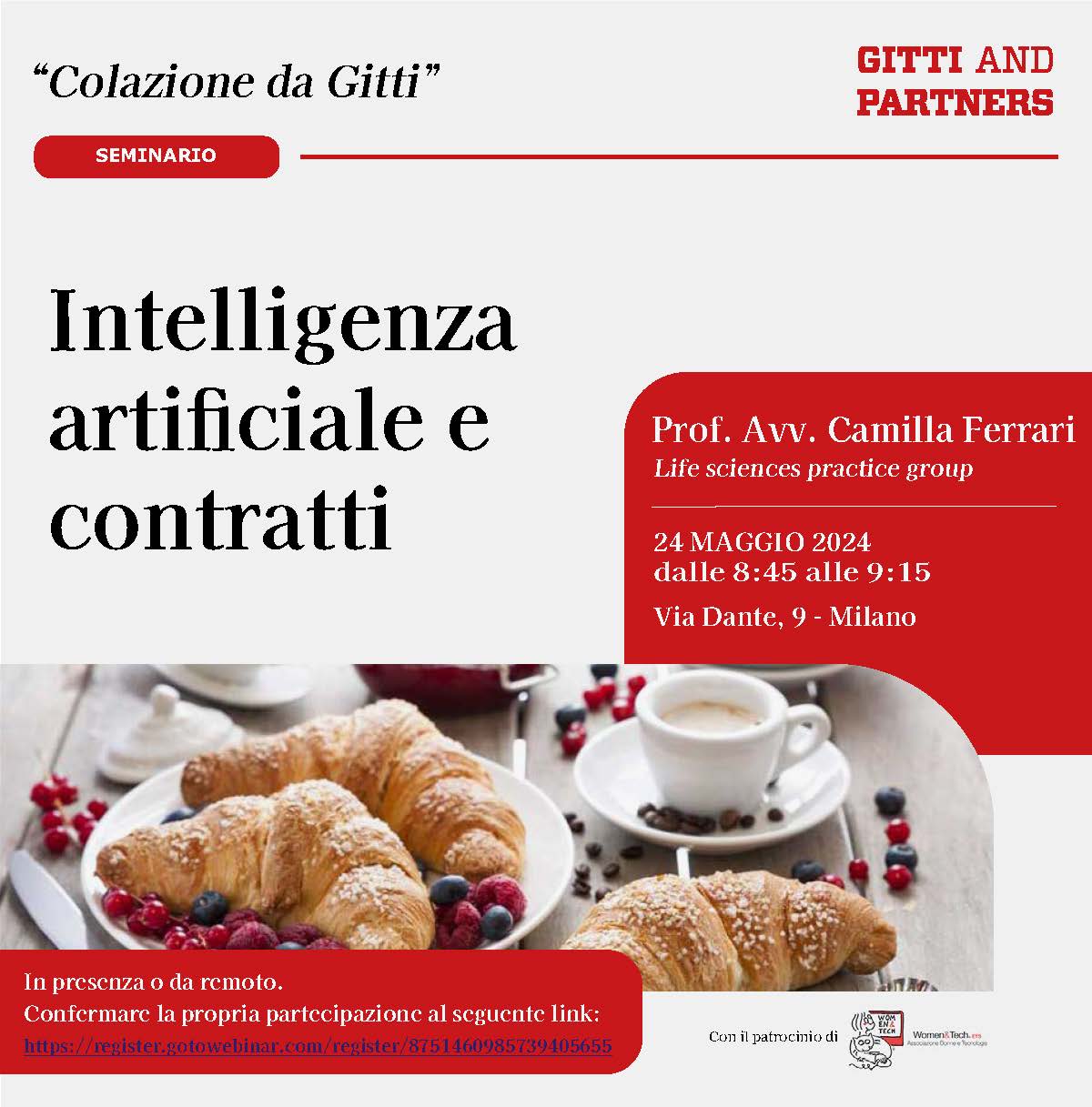
AI Breakfasts Continue

Our breakfast presentation series dedicated to AI continues. Join us for our next event on May 24, 2024 at 9 via Dante in Milan! Our partner, professor Camilla Ferrari of the University of Milan, will be speaking about the impact of AI on contracts.

Curious about past presentations on AI and AI liability? You may find below our slides (in Italian).

Tier 2!

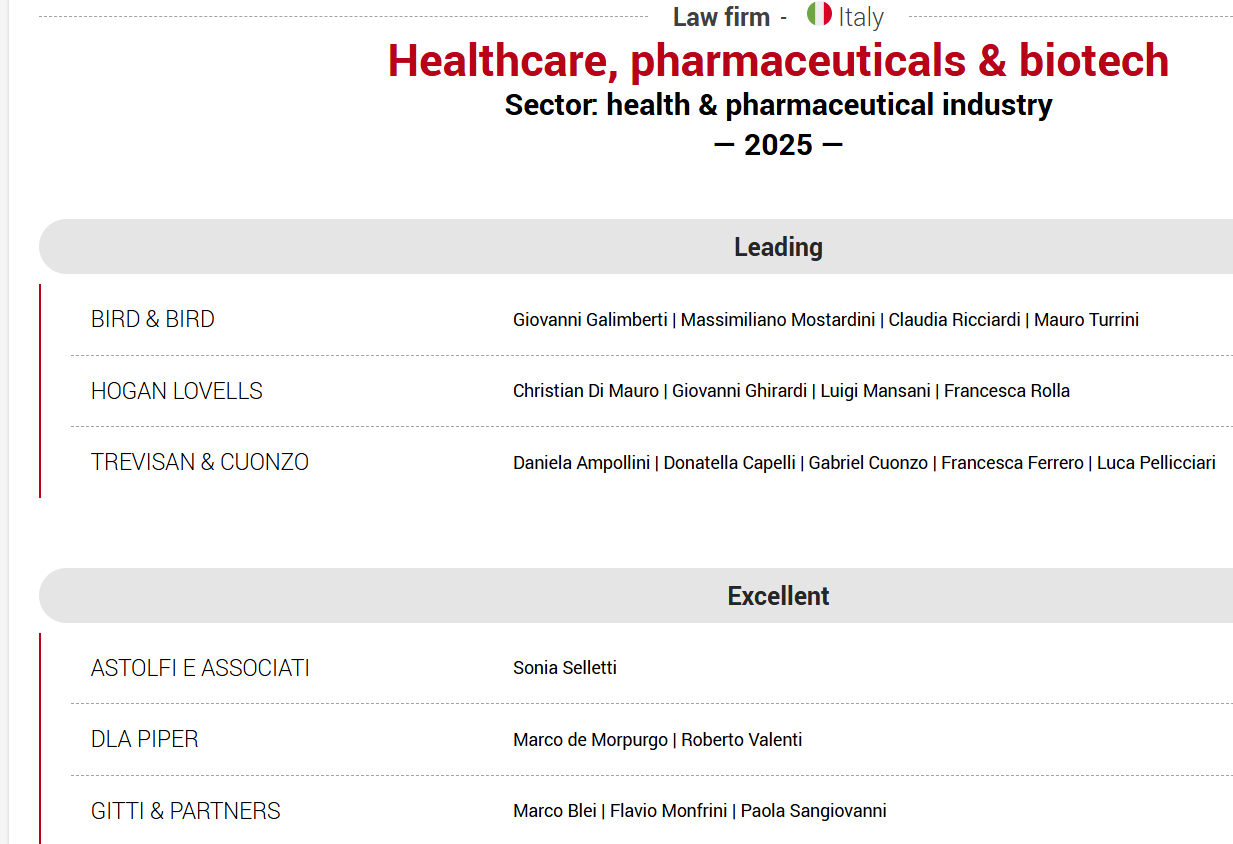
The rankings of The Legal 500 are out and this year Gitti and Partners’ life sciences practice has been recognized as a “Tier 2” firm, with Paola Sangiovanni as “Leading Individual”.

Check out the rankings here:

https://www.legal500.com/c/italy/industry-focus-healthcare-and-life-sciences/

A huge THANK YOU to our wonderful testimonials, but also to all of our clients, who help us get better year after year, and to our team, who makes working fun!